Trump Calls Michigan Senate Candidate a 'Jihadist'
At a rally in Port Huron, Michigan, on October 25, President Trump called Democratic Senate candidate Abdul El-Sayed a "jihadist" who was "on the side of the terrorists". El-Sayed would be the nation's first Muslim senator. Bishara Bahbah, a founder of Arab Americans for Trump, called the remarks racist. In 2024, Trump became the first Republican in 24 years to carry Dearborn, home to many Arab Americans.
Trump also said El-Sayed would "have to go through a metal detector" before entering the Senate. He compared stopping him to the passengers who fought hijackers on United Flight 93 during the attacks of Sept. 11, 2001. Republican nominee Mike Rogers faces El-Sayed for the seat of retiring Democratic Senator Gary Peters. Rogers repeated claims linking him to the Muslim Brotherhood, an Islamic movement with branches the U.S. government has designated as terrorist organizations. In their second and final debate, Rogers asked El-Sayed whether he was "for America".
According to the Associated Press, there is no evidence that El-Sayed has any affiliation with the Muslim Brotherhood. His half-sister wrote in a 2012 social media post that "my family has long been MB" and described her mother's involvement in the early 1970s; El-Sayed was raised by his father. The report includes no polling on the race.
The contest between El-Sayed and Rogers is among a handful of races that could decide which party controls the Senate. Bahbah, whose group has since renamed itself Arab Americans for Peace, said "people are going to remember that on Nov. 3."
The cards of this story
from the video, click to enlarge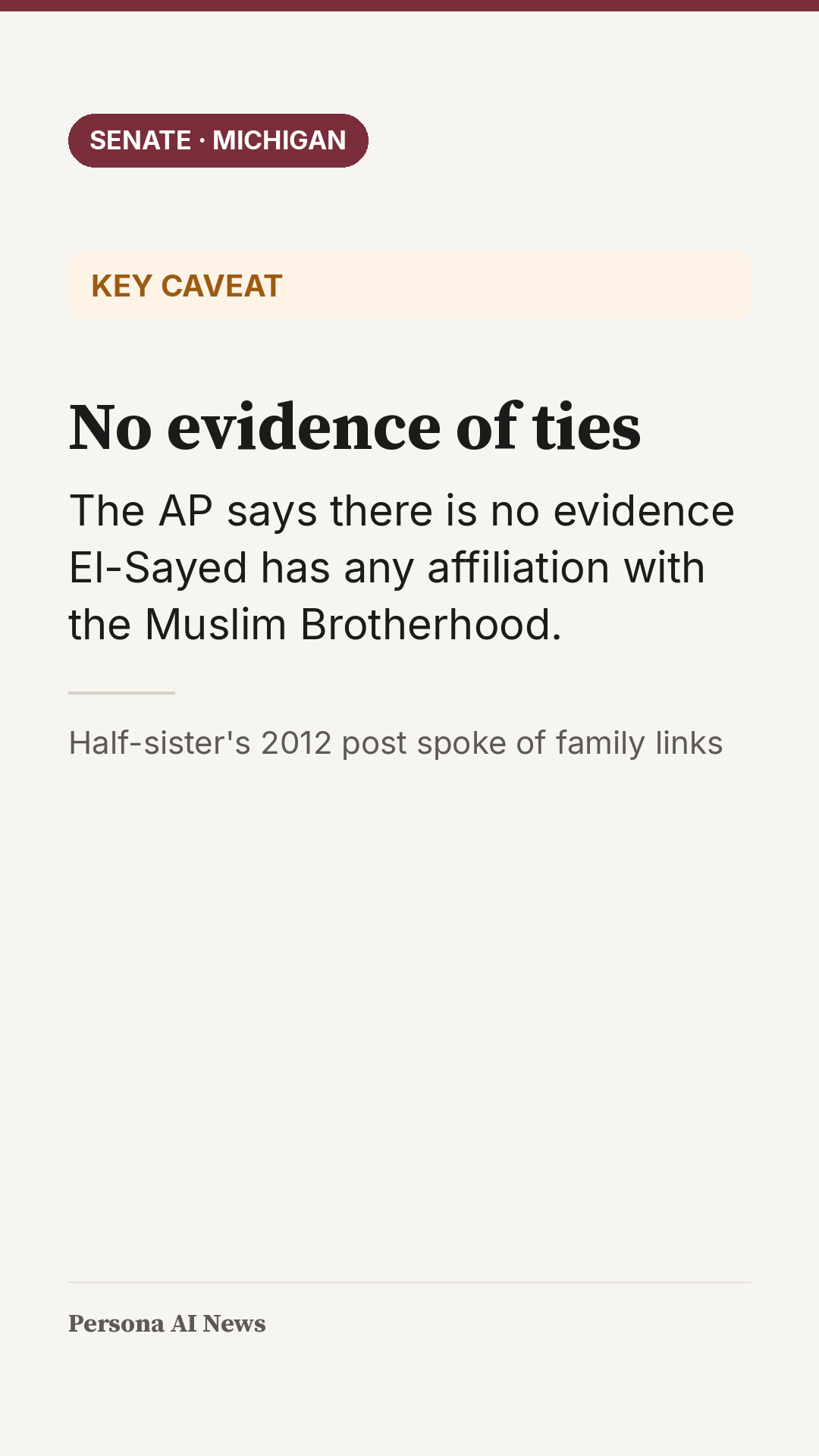
The text reports a divisive campaign controversy with concrete facts and a fact check, but it offers no solution or path forward, so it stays mostly problem description.
The text is sober and well sourced. It names dates, places, and people, and it notes that the Associated Press found no evidence of a Muslim Brotherhood link, while also mentioning the half-sister's 2012 post and that no polling is included. It does not point to any response, fix, or constructive development beyond the political reaction of one critic. The score would rise with context on how voters or communities are responding constructively, or on how such rhetoric can be countered.
AI assessment by fixed criteria. How we score →